crewship
Install
$ docker run -p 8080:8080 crewship/crewship:latest

All hands on your deck.

Command a crew of your own.

Crewship gives you an AI workforce of your own — self-hosted, organized, ready. Hand them a goal. They plan, split the work, and bring it to port. For the first time, you don’t have to build alone.

Orchestrates the CLIs you already use — Claude Code, Codex, Gemini, OpenCode. Your subscriptions, your rate limits, your data path.

GitHub
crewship — mission timeline
LIVE
MISSIONbuild-landing-page06:4212 events
Crew · 4 agents · 4 providers
Alex · Claude CodeChen · CodexMaya · GeminiSofia · Ollama
  • plan.draftAlex · 12s
  • research.gatherMaya · 34s
  • code.generateChen · running…
  • review.pendingSofia · queued
summary.generated

Landing scaffolded across 4 providers. 3 components built. Cost: $0.041. Awaiting review.

  • Anthropic
  • OpenAI
  • Google
  • Meta
  • Perplexity
  • Ollama

Plus any OpenAI-compatible router or endpoint.

Who’s aboard

Same ship.
Different crews.

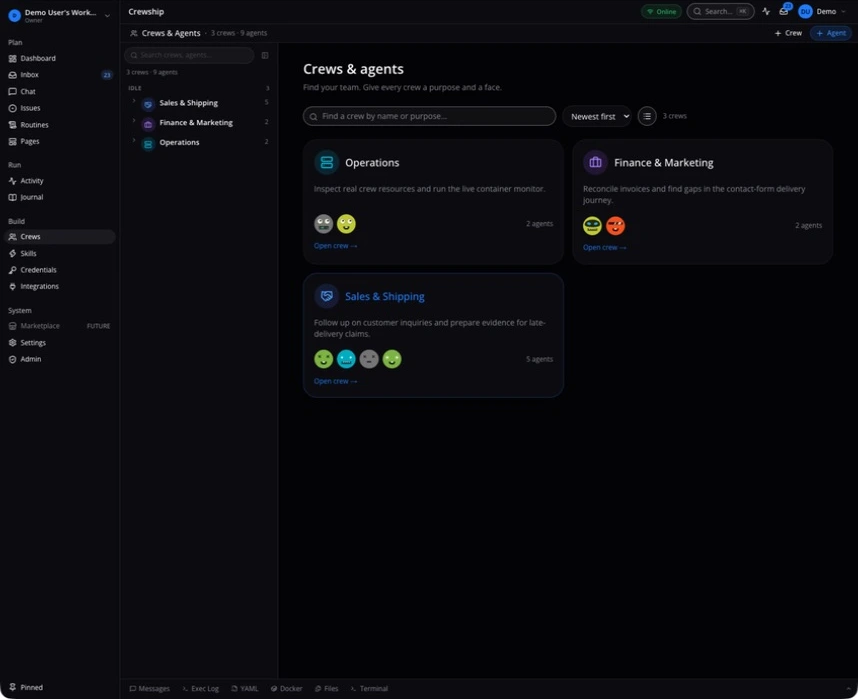
One platform, eight live pipelines — and any you can describe. Each crew runs in its own container, picks the CLI best for the job, and lands every action in the journal.

What’s under the deck

Built so a crew can run unattended.

crewship — bash
$ crewship up --crew research
✓ Container started
✓ 3 agents online
✓ Journal connected
research
Docker
Any provider
Paymaster
Your keys
Flagship

Self-hosted.

Runs on your infra. Data never leaves your network. No SaaS middle-hop, no vendor hostage. You own the ship.

your VPCyour serversyour keys
Container-isolated
One Docker per crew. Prompt injection stops at the boundary.
Human-in-the-loop
Pause at any hop. Wait for your approval before the next call.
Mix any providers
Claude, GPT, Gemini, or a local model — chosen per agent, per task.
Fully backed up
Every state snapshotted. Replay any crew from any point. Nothing lost.
Budget-capped
Hard stop before the call is made — at workspace, crew, or agent level.

Point a crew at anything. Below: three views into one crew at work.

See all modules
real screenshot soon
Crew Journal LIVE
execcostapprovalcheckpoint
  • exec.started0.3s
    anna@finance · python reconcile_invoices.py
  • cost.incurred$0.012
    gpt-4o · 1,820 tok · finance
  • approval.requestedpending
    transfer over $10k → harbormaster
  • guardrail.blockedlookout
    prompt-injection signature · qa crew

The logbook — every action across every department, preserved.

Stop 01

Crew Journal

The ship’s logbook — every action, preserved.

Append-only event stream. Every move every crew makes, kept and queryable.

Reconciliation runs, code commits, LLM calls, approvals — it all lands in one typed stream. Audit trail, cost attribution, memory retrieval, approvals — each is a read-model over the same source of truth. Same pattern as core banking ledgers: immutable, tamper-evident, replayable.

  • 25+ typed entry kinds (exec, cost, approval, checkpoint, network, guardrail…)
  • Append-only, tamper-evident, signed — same principle as core banking ledgers
  • Filterable timeline in the UI, queryable as SQL / via API
  • Foundation for Episodic Memory (vector recall) and Paymaster (cost ledger)
real screenshot soon
Crow's Nest owner-only
╭─ @anna · finance $ python reconcile.py
⠋ matching invoices…
47 reconciled · 2 flagged
╰─ exit 0
╭─ @chen · engineering $ pnpm build
CPU
MEM
NET
2.1

The watchtower — live view across every crew, every department.

Stop 02

Crow's Nest

The watchtower — every crew under live observation.

Live terminal, network, filesystem, and resource view for every crew. Owner/Admin only.

When an agent runs in a container, you want to see exactly what it's doing — whether it's a finance crew reconciling invoices or an engineering crew running a build. Crow's Nest streams the live terminal, network connections, filesystem access, and CPU/memory usage in real time, across every crew in your workspace.

  • Live exec streams with ANSI colors, via xterm.js
  • Active network connections + allowed outbound domains
  • Filesystem view with read/write/exec provenance
  • CPU/memory sparklines updated via WebSocket
real screenshot soon
Paymaster 1 over
Total spend
$24.10
Calls
2,184
Avg / mission
$0.04
Top crew
Engineering
workspace$24 / $100
finance-crew$5 / $20
› close-q3-books$1.2 / $5
engineering-crew$12 / $50
qa-crew$7 / $6

The accountant — budgets per department, hard stops before the bill arrives.

Stop 03

Paymaster

The accountant who stops you before the bill arrives.

Hierarchical LLM budgets across departments — workspace → crew → mission → agent. Hard stops, not surprises.

Every LLM call goes through Paymaster first. Finance crew running over budget? Capped before the bill grows. Tight on a particular mission? Cap it independently. Run a million-call evaluation on a loop without fear — the accountant is watching.

  • 4-level hierarchy: workspace → crew → mission → agent
  • Cost normalized across providers — compare Claude, GPT, Gemini, local models in $/token
  • Soft warnings + hard stops (configurable per level)
  • Full ledger in the Crew Journal — exportable, auditable

What a crew does

Plug it in.
Anyone in the team can ask.

Crewship wires into your real sources — docs, repos, wikis, ticket systems, internal tools — and turns them into something your team can query. Works the same way for a 200-person company, a 4-person startup, or a community-run open-source project.

Marketing asks

Anyone asks, the crew answers.

Where's our messaging for enterprise customers in AI?
marketing crew · 0.8 s
  • Brand book v3 · page 42
  • Q3 enterprise campaign · brief
  • Sales deck · enterprise tier

Plug in Drive, Notion, your wiki, your repo. The crew searches across all of it, cites the sources, and answers in your team's language — not generic web results.

Engineering asks

Long routines run themselves.

Reconcile yesterday's invoices and flag exceptions.
ops crew · 12 m
  • 47 invoices reconciled
  • 2 flagged · over $10k threshold
  • Journal · 49 entries logged

Reconcile, generate weekly reports, triage tickets, summarize releases. The crew runs end-to-end, escalates only the edge cases, and logs every action so you can verify what happened.

Lead asks

One source of truth for everyone.

What did each crew ship this week?
all crews · 0.3 s
  • engineering · 7 PRs merged
  • marketing · 2 campaigns shipped
  • ops · 1 incident · resolved

Every move every crew makes lands in the Journal. Founders, leads, contributors — same data, role-gated views. No 'what's happening on the other team' status meetings.

Where Crewship sits

Not a cloud tool. Not a Python library.

Between “one cloud agent” and “build it yourself with CrewAI” — that’s where Crewship lives.

6 differentiators · where we win
Crewship
self-hosted platform
Claude Code
Anthropic CLI
CrewAI
Python framework
AutoGen
MS Python framework
Drop-in self-hosted runtimeOne Go binaryVendor cloudLibrary, you wireLibrary, you wire
Mix CLIs in one crewClaude · GPT · Gemini · OllamaAnthropic onlyAPI wrappers, manualAPI wrappers, manual
Human-in-the-loop approvalsHarbormaster gatePer-tool promptDIYDIY
Hierarchical LLM budgetsWorkspace → agentPer-user cap
Audit trail (typed journal)25+ entry kindsSession logBYO telemetryBYO telemetry
Live observability UICrow's NestLangSmith addon

Not competitors we’re trashing — tools we’re complementing. Crewship runs Claude Code inside a crew.

Built in public

We ship fast. You vote on what's next.

Every release is on GitHub the moment it merges. Every feature on the roadmap is open for discussion. Upvote on GitHub — we ship in order.

Stars
0
Forks
0
Merged PRs
0
Contributors
0

Recently shipped

full changelog

You decide what's next

discuss on GitHub

Kubernetes container provider

planned

Run crews as K8s pods. Horizontal scale, namespace per workspace, standard RBAC integration.

discussion

MCP bridge for tools

considering

Expose any MCP server to all agents in a crew — gated by Keeper, logged in Journal.

discussion

Public skills marketplace

considering

Curated, sandbox-enforced skills. Every install is reviewed and runs inside crew boundary.

discussion

Questions

Things people ask.

Real answers to the questions we hear most. Still curious? Ask in Discussions.

Yes — this is the core of how Crewship works. Each agent in a crew can run a different CLI. For example: your LEAD agent runs on Claude Code for orchestration, a researcher agent runs on Gemini for its long context window, a coding agent runs on Codex, and a sensitive-data scout runs on OpenCode (open-source CLI). Failover pools mean if one provider goes down, the crew keeps working.
Not in the short term. Self-hosting is not a pricing tier for us — it is the identity of the product. Crewship exists because AI tools that run in someone else's cloud, with someone else's credentials, are not really yours. A managed hosted option may eventually appear alongside the open-source core (Apache-2.0), but it will always be optional. The self-host path will never be deprecated.
Yes — Crewship runs every crew in an isolated container. You need either Docker Desktop (macOS/Windows), Docker Engine (Linux), Podman, or Apple Containers (macOS 26+) installed. Kubernetes support is on the roadmap.
CrewAI and LangGraph are Python libraries — you build your own runtime around them. Crewship is a complete self-hosted platform: one binary, a UI, container isolation, audit trail, budgets, approvals, and credential vault. They're complementary — you can wrap either library inside a Crewship crew.
Yes. Crewship orchestrates official CLIs from Anthropic (Claude Code), OpenAI (Codex), Google (Gemini), and OpenCode (open-source). Mix any combination per agent — if one vendor changes terms or has an outage, swap that agent's CLI without touching the rest of the crew. Native Ollama-as-runtime support is on the roadmap.
Yes. Crewship invokes the claude CLI inside each agent container, authenticated with whatever credentials you mount. If you have a Claude Max / Pro / API plan, Crewship uses the same limits your account has.
Paymaster enforces budgets at every level: workspace → crew → mission → agent. Hard stops before the call is made, not after the bill arrives. You can also gate high-cost actions via Harbormaster (human approval).
The Apache-2.0 core includes everything listed on this page — Journal, Paymaster, Keeper, Harbormaster, Cartographer, Crow's Nest. Enterprise adds SSO/SAML, cross-workspace federation, priority support and a curated marketplace. EE is a drop-in extension, not a fork.
Your database is yours — PostgreSQL or SQLite, depending on your setup. Everything lives in `journal_entries` (append-only) and standard relational tables. Export, migrate, archive — no lock-in.
Containers are the correct security boundary for untrusted code — this is a pattern from core banking systems. An AI agent executes arbitrary tool calls, writes files, and makes network requests based on LLM output. When prompt injection happens (and it will), the container stops the damage at the boundary: non-root UID, capability-dropped, read-only rootfs optional, network policy configurable. Processes share everything with the host. That is not acceptable for agents.
Welcome aboard.

Set up your crew
in one command.

Docker, Podman, or Apple Containers required. Everything else is in the binary.

Stay aboard

The weekly
changelog.

New crews, breaking ideas, what we shipped. One short email per week, unsubscribe anytime.

No spam, no third-party sharing. Plain-text email, unsubscribe link in every issue.

FREE forever

Apache-2.0 core. Journal, Paymaster, Keeper, Harbormaster, Cartographer — all of it, forever.

Community

Discord, GitHub Discussions, weekly changelog. Build in public.

soon
Enterprise

SSO, federation, marketplace, priority support. Join waitlist →